
Explore the biggest health technology trends of 2026, including AI diagnostics, telemedicine, wearable devices, digital twins, and smart healthcare innovations.
Updated: June 2026 | 15-min read | SEO-Optimized Article
Introduction
Healthcare is changing fast, and health technology is playing a growing role in that transformation. In 2026, the conversation has shifted from experimentation toward real-world deployment. From AI-assisted medical imaging to smartwatches that can monitor important health signals, new technologies are changing how patients receive care and how healthcare professionals deliver it.
These changes are not limited to hospitals and doctors. They affect patients, caregivers, and anyone who uses modern healthcare services. In this guide, we’ll explore the most important health technology trends of 2026, including AI-powered diagnostics, telemedicine, wearable devices, digital health tools, and other innovations shaping the future of healthcare.
This isn’t just a story for doctors and hospital executives. It affects every one of us — patients, caregivers, and anyone who interacts with the healthcare system. Whether you’re curious about AI in healthcare, wondering what telemedicine looks like today, or trying to understand how wearable health technology is evolving, this guide breaks it all down in plain language.
Let’s explore the most important health technology trends shaping healthcare in 2026 and see how these digital innovations could influence the future of care.
What Are Health Technology Trends in 2026?
Health technology refers to any tool, device, software, or system designed to improve medical care or to support the people who deliver it. That covers everything from the app on your phone that tracks your sleep to the AI system that helps a radiologist spot cancer earlier.
In 2026, health technology trends 2026 have movAI scribes becoming increasingly common as part of health technology trends 2026. Healthcare organizations spent the last several years running pilot programs and testing health technology trends 2026 in real-world clinical environments. Many of these digital health initiatives are now being tracked and evaluated through industry resources such as HIMSS Digital Health programs. Now, they’re scaling what works — and focusing on technologies that solve genuine problems, not just impressive-sounding ones.
Why 2026 Is a Turning Point for Digital Healthcare
Several health technology trends 2026 have converged at once. AI has matured significantly. Wearable devices are more accurate and more affordable. Telemedicine infrastructure built during the pandemic never went away — it kept growing. And patients have higher expectations than ever for convenient, personalized care.
Smart healthcare solutions are becoming one of the most influential health technology trends 2026 in everyday clinical practice. Here’s what that looks like in action.
AI in Healthcare — A Leading Health Technology Trend 2026
If there’s one trend dominating every healthcare technology conversation in 2026, it’s artificial intelligence. But what’s changed is the depth. AI is one of the most important health technology trends 2026 and is no longer just a research topic. — it’s actively working inside clinics, labs, and emergency rooms right now.
Businesses are also using AI-powered tools to improve productivity, automate tasks, and streamline operations.
AI-Powered Diagnostics and Medical Imaging

One of the most impactful applications of AI in healthcare is medical imaging. AI systems can now analyze CT scans, MRIs, and X-rays with remarkable speed and accuracy, flagging anomalies that might be easy to miss in a high-volume radiology department.
For example, AI tools are already being used to detect colon polyps during live colonoscopies and identify early signs of heart disease from routine scans. Some pulse oximeters — those little finger-clip devices that measure blood oxygen — have used AI to improve measurement accuracy for years. What’s new is how far that capability has spread.
| �� Real-World Example: Medtronic reports that AI diagnostic tools are now detecting heart disease and colon polyps in real time during standard procedures — reducing the chance of missed findings that would otherwise go undetected until a more advanced stage. |
The key benefit here isn’t replacing doctors. It’s giving clinicians a highly capable assistant that can process enormous amounts of data instantly, surface the most urgent findings, and let physicians focus on what they do best: making human-centered decisions.
AI Scribes and Clinical Documentation
Ask any physician what burns them out most, and documentation usually tops the list. AI scribes — tools that listen during patient consultations and automatically draft clinical notes — are becoming increasingly common in 2026.
Tools like Microsoft’s DAX Copilot are reducing the administrative burden on clinicians by handling structured note-taking in real time. That gives doctors more time to actually look at and talk with their patients, which is good for everyone.
This is a great example of AI in healthcare that improves the experience without replacing any clinical judgment — it just removes the friction.
Telemedicine and Virtual Care in 2026
Telemedicine was already growing before 2020, but the pandemic accelerated its adoption by years in a matter of months. In 2026, Virtual care is now a core part of health technology trends 2026 and modern healthcare delivery. — it’s a core part of how healthcare is delivered.
Hospital-at-Home Models and Telemedicine
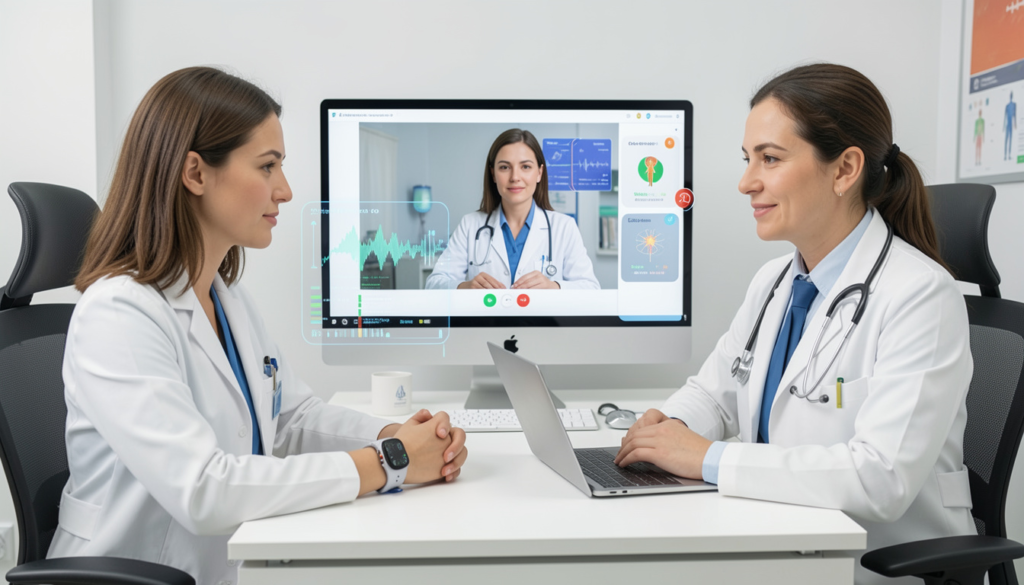
One of the most striking health technology trends 2026 is the hospital-at-home movement. Patients who would previously require in-person hospital admission are now receiving acute care in their own homes, monitored remotely through connected devices and supported by regular virtual check-ins.
This model works particularly well for conditions like heart failure, pneumonia, and post-surgical recovery. Patients tend to recover faster at home, and it frees up hospital beds for more critical cases. It’s a win on multiple levels.
Virtual Mental Health and Chronic Disease Management
Mental health services have been one of the biggest beneficiaries of telemedicine growth. Access to therapists and psychiatrists via video call has dramatically reduced barriers for people in rural areas or those with mobility challenges.
Similarly, chronic disease management — for conditions like diabetes, hypertension, and asthma — is increasingly handled through virtual appointments paired with remote patient monitoring. Patients check in regularly without taking time off work for a 15-minute in-person visit.
• Reduced travel time and cost for patients
• Better access to specialists regardless of geography
• More frequent touchpoints for managing chronic conditions
• Improved adherence to treatment plans with digital reminders
• Lower no-show rates compared to in-person appointments
Wearable Health Technology — A Major Health Technology Trend 2026
As one of the leading health technology trends 2026, wearable health technology has come a long way from step counters. In 2026, the devices people wear on their wrists, in their ears, or even as patches on their skin are generating clinically meaningful data — and healthcare providers are taking notice.
Smartwatches and Continuous Monitoring Devices
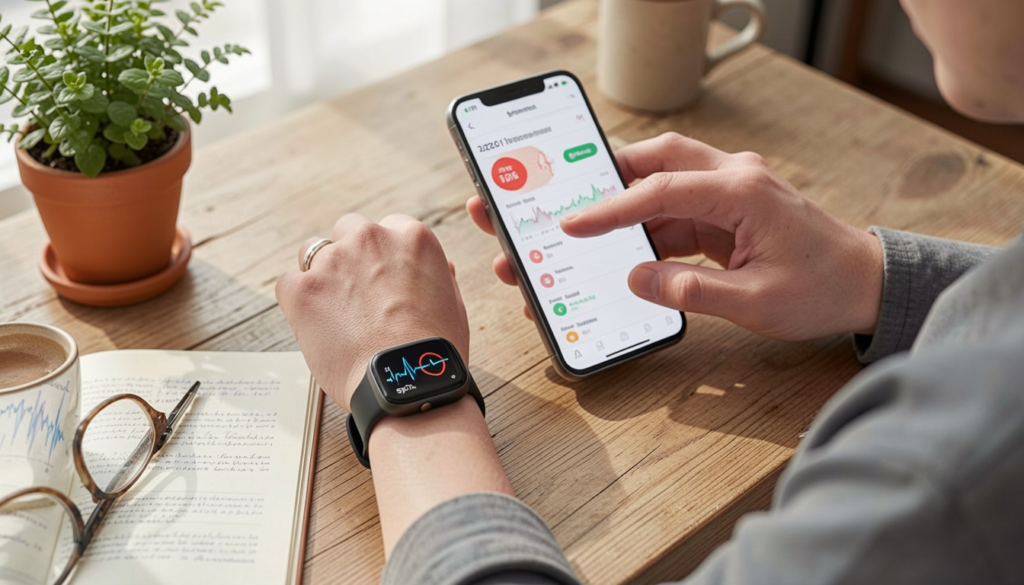
Modern smartwatches can detect irregular heart rhythms, measure blood oxygen levels, track sleep stages, estimate stress levels, and even detect early signs of conditions like atrial fibrillation. Some newer devices are adding continuous glucose monitoring capabilities, which is a significant development for people managing diabetes.
The real power of wearables isn’t in any single reading — it’s in the continuous stream of data they provide. A one-time blood pressure reading at the doctor’s office gives a snapshot. A wearable that tracks your blood pressure variability throughout the day tells a much richer story.
Wearables in Clinical Trials and Remote Patient Monitoring
Healthcare organizations are using wearables as one of the most promising health technology trends 2026 to modernize clinical trials. Instead of requiring participants to visit a clinic every few weeks, researchers can collect real-time physiological data continuously and remotely.
This makes trials more efficient, more inclusive (participants don’t need to live near a research center), and produces richer data sets. It’s one of the more exciting medical technology trends because it speeds up the path from research to treatment.
Digital Twins — An Emerging Health Technology Trend 2026
The concept of a digital twin might sound like science fiction, but it’s quietly becoming one of the most promising innovations in future healthcare technology. A digital twin represents one of the emerging health technology trends 2026, creating a virtual model of a patient. — built from their clinical data, physiological measurements, genetic information, and lifestyle factors.
Imagine a doctor testing different treatment options on a virtual patient before making a real-world decision. That’s exactly why digital twin technology is attracting so much attention in modern healthcare.
The idea is that clinicians could test different treatment approaches on the digital version of a patient before deciding what to do with the real person. If a surgeon wants to understand how a patient’s heart will respond to a specific procedure, a digital twin could first simulate the outcome.
We’re not at the stage of comprehensive human digital twins yet, but partial versions are already being used in cardiology and orthopedics. Patients in these specialties are starting to benefit from more personalized treatment planning based on their individual physiological profiles — not just general population averages.
This is what truly patient-centered care looks like when it has the computational power to back it up. These innovations are part of broader future technology trends that are transforming industries worldwide.
Smart Healthcare Solutions — Automation and Workflow Innovation
Beyond individual technologies, 2026 is seeing a wave of smart healthcare solutions designed to make the entire system run more efficiently. Healthcare organizations are using health technology trends 2026 to address staffing shortages and improve efficiency, rising costs, and increasing patient loads — and automation is part of how they’re coping.
AI Chatbots and Virtual Health Assistants
Not every health question needs a physician. AI-powered virtual assistants are handling the routine stuff — appointment scheduling, medication reminders, basic triage questions, prescription refill requests — 24 hours a day, seven days a week.
This frees up clinical staff to focus on complex, high-value interactions, while patients get faster responses to straightforward queries. When these assistants connect directly with electronic health records, they can provide genuinely personalized responses rather than generic information.
Cybersecurity as a Patient Safety Issue
Here’s a trend that doesn’t always make the exciting-technology lists, but absolutely deserves attention: Cybersecurity has become one of the critical health technology trends 2026 because patient safety depends on secure systems.
Hospitals rely on interconnected networks of devices, electronic records, and cloud systems. Ransomware attacks on healthcare infrastructure have real consequences for patients — delayed surgeries, inaccessible records, disrupted care. In 2026, the U.S. FDA has introduced new guidance specifically addressing cybersecurity in connected medical devices, and governments globally are getting involved.
Robust data governance and cybersecurity aren’t optional features anymore. They’re part of what it means to deliver safe, reliable care.
Future Health Technology Trends 2026 — What’s Coming Next
Looking beyond 2026, several emerging health technology trends 2026 are worth watching. These are technologies in earlier stages of deployment, but with significant potential to reshape healthcare in the years ahead.
• Ambient AI in clinical settings: Always-on AI systems that passively monitor patient vitals, flag deteriorating conditions, and support clinical decision-making without requiring active input from staff.
• Genomic medicine and precision therapeutics: As genetic sequencing becomes faster and cheaper, treatments tailored to individual genetic profiles will become more common, particularly in oncology.
• Augmented reality in surgery: AR systems that overlay patient data, imaging, and guidance onto a surgeon’s field of view during procedures, improving precision and reducing errors.
• Blockchain for health data security: Decentralized record-keeping that gives patients more control over their data while making it more secure and interoperable across healthcare systems.
• AI-driven drug discovery: Machine learning platforms are accelerating the identification of potential drug compounds, potentially cutting years off the development timeline for new treatments.
Final Thoughts
The most important health technology trends 2026 are not some distant future — they’re happening right now, in hospitals, clinics, and living rooms around the world. AI is catching diseases earlier. Wearables are giving us continuous health data that was impossible to collect a decade ago. Telemedicine is making care more accessible. And digital twins are edging us closer to truly personalized medicine.
None of this replaces the human elements of healthcare — the compassion, the clinical judgment, the relationship between patient and provider. What it does is remove friction, reduce errors, and give clinicians better tools to do what they trained to do.
The most important thing to understand is that these aren’t separate technologies — they work together. An AI system that analyzes your wearable data and flags it for your virtual-care physician, who then adjusts your treatment plan in an electronic health record you can access from your phone — that’s not the future. That’s 2026.
Frequently Asked Questions
Q: What are the biggest health technology trends 2026 shaping healthcare?
A: The leading health technology trends 2026 include AI-powered diagnostics. and clinical documentation, the expansion of telemedicine including hospital-at-home models, advanced wearable health monitors, digital twin technology for personalized treatment planning, and AI chatbots handling routine healthcare interactions. Cybersecurity has also emerged as a critical patient safety priority.
Q: How is AI being used in healthcare right now?
A: AI is being used to analyze medical images like MRIs, CT scans, and X-rays, helping clinicians catch diseases earlier. It’s also powering AI scribes that handle clinical documentation automatically, virtual health assistants that manage patient queries, and predictive analytics tools that help hospitals anticipate patient needs and manage resources.
Q: Is telemedicine still growing in 2026?
A: Yes — and significantly. Telemedicine has evolved well beyond basic video calls. Hospital-at-home programs, virtual chronic disease management, remote patient monitoring, and telepsychiatry are all expanding. The infrastructure built during the pandemic has continued to mature, and many insurers now offer standard reimbursement for virtual visits.
Q: What can wearable health technology actually detect?
A: Modern wearables can monitor heart rate and rhythm (including detecting atrial fibrillation), blood oxygen levels, sleep quality, stress markers, and, for some devices, blood glucose levels. Clinical-grade wearables used in remote patient monitoring programs can track even more detailed physiological data for patients managing chronic conditions.
Q: What is a digital twin in healthcare?
A: A healthcare digital twin is a virtual model of an individual patient, built from their clinical, physiological, genetic, and lifestyle data. It allows clinicians to simulate how a patient’s body might respond to different treatments before deciding on a course of action. While comprehensive human digital twins are still in development, partial versions are already being used in cardiology and surgical planning.
Q: Are digital health solutions safe and private?
A: Privacy and security are active concerns in digital healthcare. Reputable platforms comply with regulations like HIPAA (in the U.S.) and GDPR (in Europe). The FDA has also issued new guidance on cybersecurity requirements for connected medical devices. That said, patients should always check the privacy policies of any health apps they use and ask their providers about how their data is stored and shared.
Q: Will AI replace doctors?
A: No. AI in healthcare is designed to assist, not replace, medical professionals. It handles tasks that involve processing large volumes of data quickly — like reviewing thousands of medical images or drafting clinical notes — but clinical judgment, patient relationships, and complex decision-making remain firmly in the domain of trained healthcare professionals. Most clinicians view AI as a tool that helps them do their jobs better, not a replacement.